Ducks
Across the River and into the TreesDucks in Across the River and Into the Trees are not merely quarry: they are wild animals whose movement and behavior determine the rhythm of the marshland hunts, and whose presence connects the Colonel’s present-day life with remembered landscapes of war. Mallards, pin-tails, and widgeon appear in distinct circumstances, while decoys, callers, guns, and frozen water place the birds within a human practice that depends on reading their habits. The hunts give the ducks practical value, but their flight, wariness, and seasonal patterns also make them forces that cannot be fully managed by the hunters.
Species and Setting
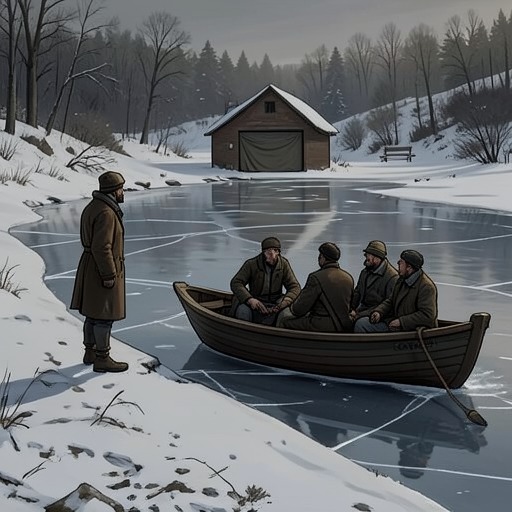
The book introduces the ducks through a pre-dawn expedition in the Veneto marshes. In each boat, hunters carry guns, shells, wooden decoys, and sometimes a live mallard hen or a hen and drake; dogs shift uneasily as wings pass overhead in the dark. The boats divide among canals and lagoons, but the sixth boat reaches a shallow lagoon covered by ice formed during a sudden, windless night. The frozen surface impedes the boat’s progress, establishing the conditions that will govern both the birds’ approach and the hunters’ decisions.
The shooting place is a sunken oak hogshead, a local form of blind: a concealed position from which the shooter can wait for ducks. At daylight, the boatman sets out decoys in two groups and places a live hen mallard on the water, tethered by a string and anchor. Her calls and movements are intended to draw other birds toward the lagoon. The scene makes the hunt a combination of concealment, imitation, and patience, but the ice remains a material limit. The hunter can arrange decoys and open water at the edges; he cannot compel ducks to land.
The birdlife belongs to a wider watery landscape shaped by both natural conditions and human action. On the road across the Piave River, Richard Cantwell remembers wartime dead being put into canals whose gates remained under Austrian control and were closed. With little water movement, the remains stayed there until labor troops removed them and buried them near the road. In the present, ducks and geese occupy those same canals, and people fish in them. The juxtaposition does not make the birds symbols of the war; instead, it places their ordinary presence in waterways whose histories are inseparable from military use and altered water flow.
The Hunt and Its Techniques
Cantwell’s shooting is presented as a practiced skill requiring attention not only to the target but also to other people. In the first lagoon hunt, he hears approaching wings, rises from the barrel blind, and fires twice at ducks descending toward the decoys. He shoots the first well away from the boat and takes the second high and to the left, allowing it to climb clear of the boat’s line. The two birds fall on the broken ice. When the boatman warns him not to shoot toward the boat, Cantwell’s successful double already demonstrates that safe positioning is part of the craft, not an afterthought.
The caller and decoys are central to this method. The live hen bobs her head under water, raises it, and splashes water onto her back as the boatman settles her among the decoys. Later, the Colonel watches a caller attract other ducks with her persistent talk. When a group of mallards approaches low, another shot from behind him makes them flare upward; the shooter is the boatman, who fires at the birds that might otherwise have reached the Colonel. The moment exposes competition within the hunt: a carefully prepared position can be undone by another gun, and the birds’ sudden change of course registers the consequence immediately.
The same concealed setup appears on a later outing. After a meal and a drive with the other shooters, the Colonel waits in a sunken oak hogshead on a frozen lagoon. A pair of pin-tails dives in, and he kills the drake before it reaches the ice and then its climbing mate. Soon widgeon arrive in a wavering group, drawn toward the calling duck. The Colonel keeps still and waits for their turn toward the blind. Here, as in the earlier hunt, the action depends on restraint: the birds must come within reach, and a movement or a premature shot can alter their approach.
Behavior, Weather, and Limits
The ducks’ behavior changes with the weather and light, repeatedly frustrating any assumption that good technique can guarantee a full bag. In the later hunt, the broken ice freezes again and the caller no longer looks up; she has shifted from calling toward what the narrative presents as greater security. The Colonel notices that the birds can see the ice in the improved light. Rather than come in, they head toward the open sea to gather together. He has no further shooting, despite remaining ready and watching the lagoon.
Pin-tails pass high above the blind, able to see both the barrel and the decoys frozen into the lagoon, including the caller. They continue toward the sea rather than circle down. The Colonel reasons that ducks may be gathered offshore and that a punt gunner could be approaching them; a shot there might send some birds back toward his position. Yet the frozen conditions also make him consider leaving. These are possibilities, not certainties: the birds’ movements invite interpretation, but they do not give the hunter control over what will happen next.
The earlier outing likewise turns on the interaction of ice and wind. Cantwell sees snow-covered mountains beyond the marsh and feels a breeze that leads him to expect wind rising with the sun and birds flying in from the sea. He asks the boatman to break more ice around the lagoon’s edges, believing the open water might attract birds. The boatman complies, although he knows the work is unnecessary. The contrast underlines the gap between the hunter’s theory and local knowledge, while the ice and changing wind remain active conditions rather than scenery.
Food, Craft, and Meaning
Ducks matter to the people around the hunts as food and as material for craft. Cantwell tells a waiter that, if the next hunt is lucky, there may be plenty of large green-headed birds, fat from feeding on what he describes as Russian food, and that their feathers will be beautiful. He promises good eating birds and good feathers, joining the practical prospect of a meal to admiration of plumage. Earlier, he identifies mallards, pin-tails, and widgeon, and mentions geese as part of the anticipated bag. The hunt thus belongs to a local economy of eating as well as to the Colonel’s personal pleasure in shooting.
The plumage also prompts an imagined gift. Looking at a drake’s winter feathers, the Colonel devises a possible vest for Renata, with mallard skins for the back and strips of other duck skins on the front. He recognizes the practical obstacles: the birds may go to market, and no one may know how to skin and cure the hides. His idea remains an imagined gift, not an action completed in the scene. Still, it reveals how the hunted bird’s beauty persists in his attention after the shot, becoming part of a private effort to imagine giving Renata something meaningful.
The hunts balance admiration with use, and the book does not erase that tension. The birds are pursued, killed, eaten, and valued for their feathers; at the same time, they retain a kind of independence through their speed, wariness, flocking, and refusal to approach when the ice is visible. The Colonel can acknowledge that he has killed enough and shot as well as he can, yet the numbers no longer measure the whole experience. Ducks make the hunt possible, but their movements also set its limits. In the frozen lagoon, their choice to turn toward the sea leaves the hunter waiting, attentive to a living world that his skill can approach but never command.